3D casts from the practice
What does “custom-made” mean?
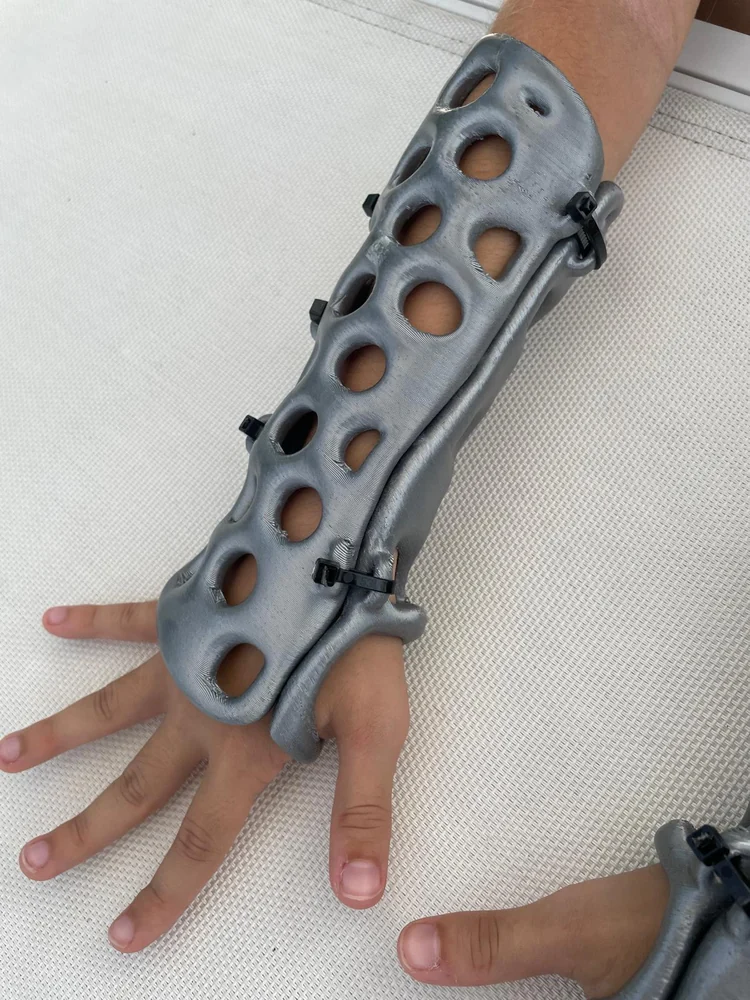
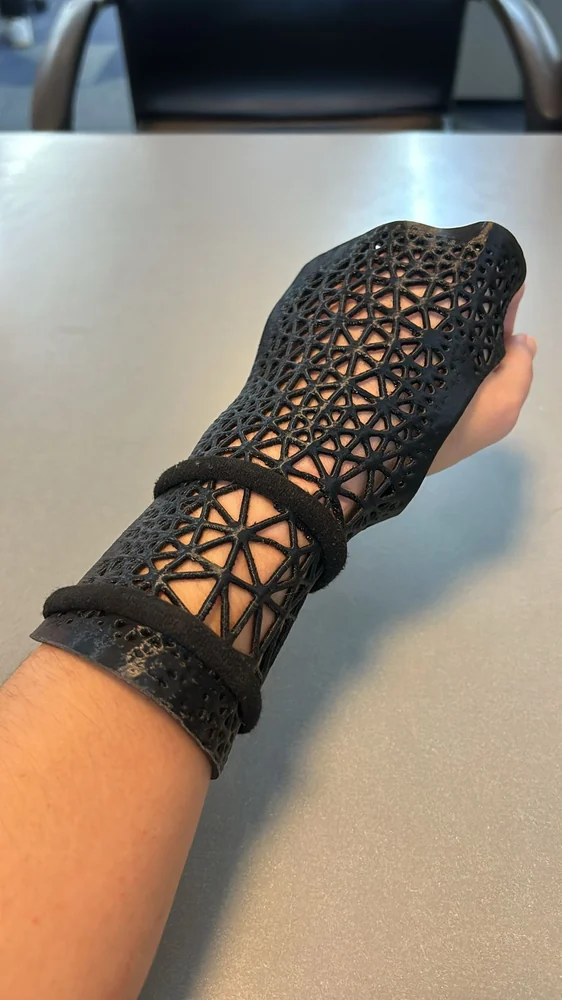
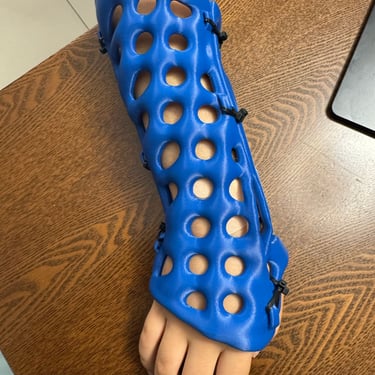
The term “3D-printed cast” usually describes a printed splint or orthosis, even though it contains no plaster. Some are designed from a scan of the limb; others use prefabricated shapes. Conventional casts are also moulded to the patient. The difference lies in how the support is designed and made, including its openings, padding and fastenings. Knowing that a device is printed does not tell you how it will feel or perform in use. [2,5,6]
Comfort and satisfaction: benefits in some studies
In 2025, Tobler-Ammann and colleagues reported a pilot trial of 19 adults with distal radius or scaphoid fractures: 10 received a 3D-printed orthosis and 9 a fiberglass cast. Average overall satisfaction was 8.4 versus 5.6 points, with less discomfort at four weeks. Radiological results did not differ significantly. This is encouraging, but comes from a small sample followed until the support was removed. [1]
Guebeli and colleagues studied 39 patients with minimally displaced distal radius fractures: 19 received a custom 3D-printed splint and 20 a fiberglass cast. Tolerance and clinical outcomes were similar, with more minor complications in the 3D group. Pain, function and healing were assessed for up to a year. The findings show why greater comfort cannot be promised for every design. [2]
Hygiene and everyday life for children
A retrospective cohort by Higgins and colleagues (2025) compared 106 children and teenagers with stable fractures: 49 had 3D-printed casts and 57 fiberglass casts. The 3D group reported easier showering and activities, and rated durability more highly. Skin irritation did not differ significantly. The lack of random treatment assignment limits the comparison. This is not permission to swim or play sports with any immobilization device. [3]
Ventilation and weight depend on the particular design
El Khoury and colleagues studied 34 adults with distal radius fractures, treated with or without surgery: 18 used a 3D-printed splint and 16 a conventional removable splint. The printed splint scored better for perspiration, coolness and water resistance, but not overall assessment. Pressure discomfort was numerically more frequent, without a statistically conclusive difference. Of nine people who tried both, eight preferred the conventional splint. The comparator was not a cast. [4]
Openings can offer practical benefits, but cannot make up for an uncomfortable fit. These studies also do not support a universal percentage reduction in weight: that depends on material, size and design. Consider the finished device, including its padding, and ask what specific advantages it offers over the available alternative.
Do they improve fracture recovery?
A trial by Ma and colleagues, published in JAMA Network Open in 2024, assigned 110 adults to optimized-design 3D-printed splints or conventional casts. It found better function at six weeks and less skin irritation, but no clinically significant functional difference at twelve weeks. The study mainly used prefabricated splints, with customization for unusual anatomy; it did not exclusively test casts made from individual scans. [5]
Feeling more comfortable or moving the wrist better at an assessment does not show that the bone heals sooner. These findings apply to the devices, injuries and follow-up used in each study. They do not automatically validate a model made at another centre or the particular cast used in this practice.
How much confidence can we place in the findings?
This article discusses four randomized trials—including one feasibility trial—and a pediatric cohort. It is a selection of original studies, not a systematic review of all the literature. They compare different supports and patient populations; combining their results as though they tested the same product would be misleading.
The observed benefits mainly concern the experience of wearing the device and some early outcomes. There are also neutral results and problems with tolerance. Larger, comparable studies are needed to identify which designs work best for particular injuries and to detect uncommon complications. Taken together, these findings cannot guarantee faster recovery or freedom from complications.
Who might be considered, and what follow-up is needed?
Much of the research concerns selected wrist and forearm fractures. The decision depends on the injury’s stability, the skin, swelling and the ability to follow care instructions. A recent injury may initially need a splint that accommodates swelling. [6,7]
Follow-up remains necessary: checking the skin and fit, assessing progress and obtaining X-rays when indicated. A support feeling light or comfortable does not, by itself, confirm that the fracture remains correctly aligned. [6,7]
Care instructions and when to seek help
Check whether your particular device can get wet and how to clean it: a water-resistant shell does not make the entire support waterproof. Follow lifting and activity restrictions, and do not remove or modify it on your own. Do not insert objects underneath it to scratch. [6]
Seek urgent assessment if pain clearly worsens, fingers become numb, blue or pale, or you lose the ability to move them. Also contact your care team if the support breaks, becomes too tight or loose, or you develop discharge, an unpleasant smell or fever. [6,7]
Useful questions for your appointment
What does my injury need immobilized? What benefit could this design offer in my case? Can it get wet or be removed, and when? How will the fit be checked? Which reviews, possible replacements and costs are included? These questions help you choose an option for its practical value and plan follow-up from the start.
Sources and further reading
- [1] Tobler-Ammann et al. Journal of Hand Therapy (2025). Acceptability and safety of 3D printed wrist-based orthoses compared to fiberglass casts: a randomized feasibility trial. DOI: 10.1016/j.jht.2024.11.004
- [2] Guebeli et al. Journal of Hand Surgery (European Volume) (2024). In-house 3D-printed custom splints for non-operative treatment of distal radial fractures: a randomized controlled trial. DOI: 10.1177/17531934231187554
- [3] Higgins et al. Journal of Pediatric Orthopaedics (2025). 3D-Printed Casts Improve Patient-Reported Function and Satisfaction in Children With Stable Fracture Patterns. DOI: 10.1097/BPO.0000000000003009
- [4] El Khoury et al. Orthopaedics & Traumatology: Surgery & Research (2022). Use of a 3D-printed splint for the treatment of distal radius fractures: a randomized controlled trial. DOI: 10.1016/j.otsr.2022.103326
- [5] Ma et al. JAMA Network Open (2024). Topology-Optimized Splints vs Casts for Distal Radius Fractures: a randomized clinical trial. DOI: 10.1001/jamanetworkopen.2023.54359
- [6] AAOS OrthoInfo. Care of Casts and Splints — orientación de cuidados / cast and splint care guidance.
- [7] NHS. Broken arm or wrist — seguimiento y señales de alarma / follow-up and warning signs.